Written for a road trip, not a trek
Packing and preparing for Adi Kailash and Om Parvat
Cold, limited space, no ATM above Dharchula and long stretches with no signal — with each item marked as either sourced fact or our own operational advice.
- Local Kumaon routes
- Clear trip guidance
- Driver-led travel
Quick answer
Pack for cold at around 4,000 to 4,500 m, for no ATM above Dharchula, and for long stretches with no mobile signal. Bring soft bags, not hard cases — space in a 4x4 is genuinely limited. Carry the permit documents, including a medical fitness certificate from an MBBS doctor, which is a required item at the counter. Accommodation in the Vyas Valley is homestays and rest houses: basic rooms, shared washrooms, limited electricity.
Inner Line Permits were suspended on 2 July 2026 and we have not confirmed that they have resumed.
Pithoragarh district administration stopped issuing Inner Line Permits on 2 July 2026 because of continuous rainfall. On 18 August 2026 the Tawaghat-Gunji road was closed by boulder falls at Malghat and Kulagad, cutting off the Vyas Valley. District officials have indicated permits may restart in September, but we have not seen that confirmed. Do not book non-refundable travel for this route until you have spoken to the SDM Dharchula office.
Last verified by us on 22 August 2026. Our dated route status page carries the full 2026 timeline and the district control room numbers, so you can check it yourself rather than take our word for it.
How to read this page. We have marked every item as either SOURCED — it comes from a government, corporation or news source we can point at — or OURS, meaning it is PahadiDrive’s own operational advice from running vehicles on this road. We think the distinction matters more on a packing page than anywhere else, because packing lists are where travel sites invent most freely.
Nothing on this page is medical advice. We are a taxi operator. Questions about altitude, fitness and medication belong with your own doctor, and we say so again below.
Cold, and the layers question
OURS. The trip spans an enormous temperature range in a short time. You will be in shirtsleeves at Dharchula at 940 m and you will be at Nabhidhang and Jolingkong at roughly 4,000 to 4,500 m on the same trip, in the same week. Those altitudes are the ones to pack for, not the average.
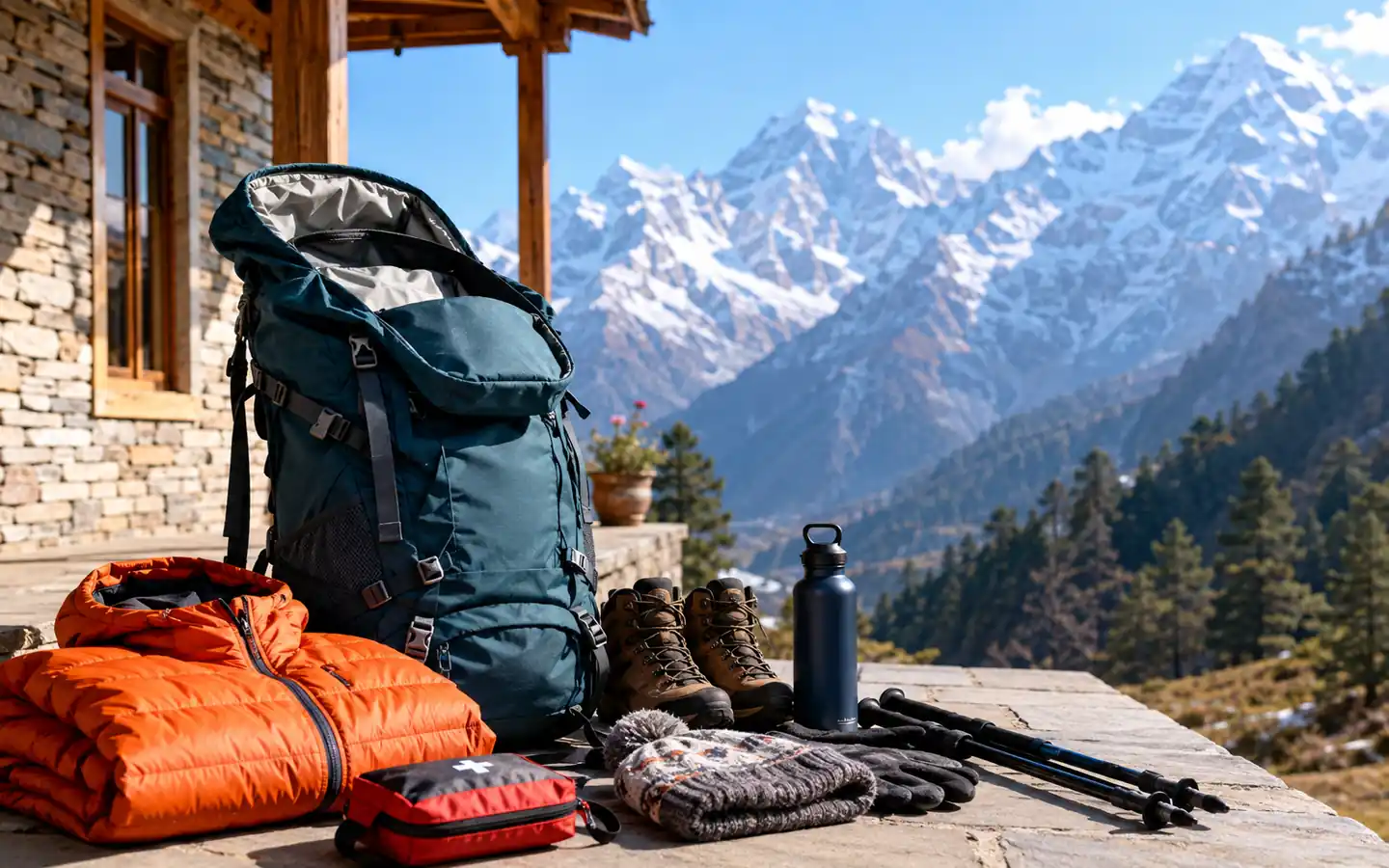
What we would carry, based on driving it rather than on a checklist:
- Layers rather than one heavy coat. A thermal base, a fleece or light down mid-layer, and a genuinely windproof outer shell. Wind at 4,500 m does more than the temperature reading suggests, and you will be getting in and out of a vehicle all day.
- A warm hat and gloves you can drive, photograph and hold a cup in.
- Warm socks and closed shoes with grip. The walking is short — this is a road trip now, not a trek — but the ground at Parvati Kund and Nabhidhang is loose, cold and uneven.
- Something warm to sleep in. Blankets are provided; heating generally is not. See the accommodation section below.
- A head torch or a torch. Electricity in the Vyas Valley is limited.
Bags: soft, not hard
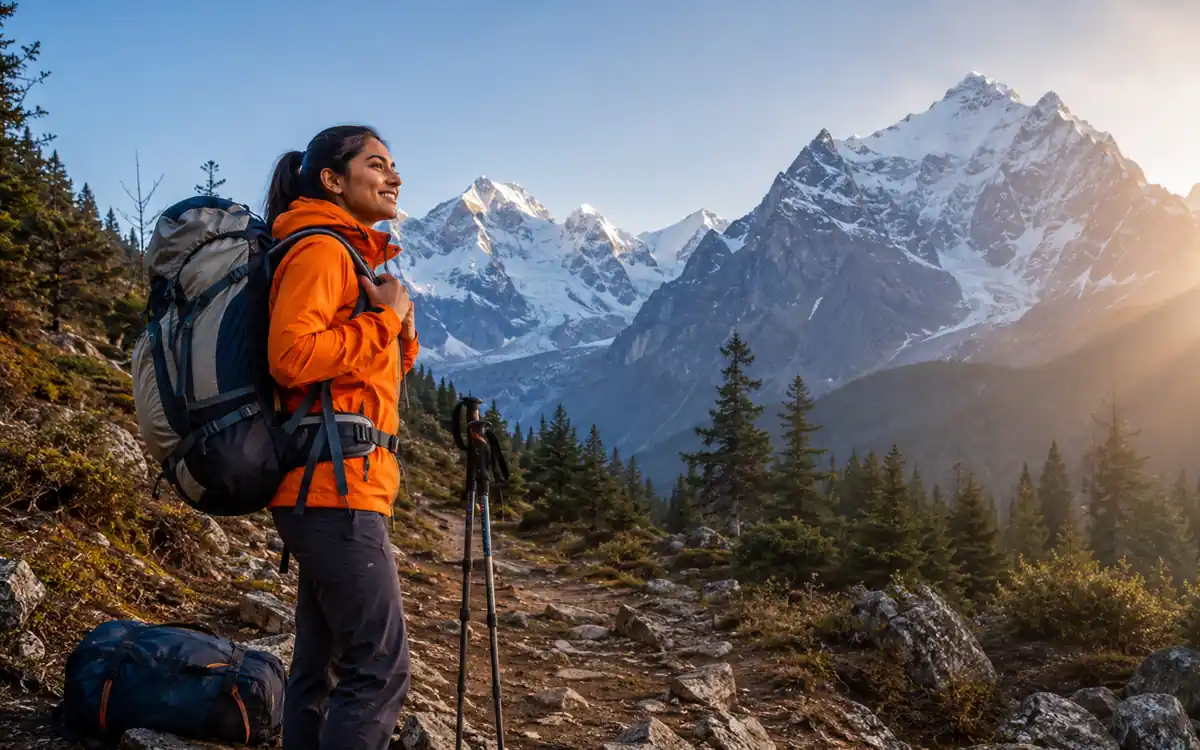
OURS, and we feel strongly about it. Bring duffels or soft holdalls. A rigid suitcase is the single most common packing mistake on this route.
The reason is simply geometry. Beyond Dharchula you are in a Bolero, Bolero Camper, Thar or Sumo class 4x4, not a highway SUV, and the load space is a fixed box that soft bags fill and hard cases do not. If your group splits across two or three 4x4s — which is what happens with larger parties, as set out on the Tempo Traveller page — then luggage has to be distributed between vehicles, and hard cases make that arithmetic worse for everyone.
SOURCED, as an indication of scale. KMVN’s 2018 Adi Kailash and Om Parvat brochure set a 15 kg luggage limit per person. That document is from 2018, when the trip was a trek, and we are not presenting it as a current rule — it may well not be one. What it tells you is the order of magnitude the state corporation itself thought realistic for this journey. If you are packing three times that per person for a road trip in a 4x4, it is worth asking why.
Cash: the ATMs end at Dharchula
Dharchula is the last dependable ATM on this route. Draw enough cash for the whole trip there, and then some.
SOURCED for the fact that Dharchula is the last reliable ATM, pharmacy and mobile signal on the way up. OURS for the advice that follows: above Dharchula you are in villages with homestays, tea shops and small provision stores. Card machines need connectivity, and connectivity is the thing you do not have. Digital payment apps need the same. Assume cash, in usable denominations, and carry more than your plan requires — because the scenario in which you need extra cash is exactly the scenario in which the road has shut and you are paying for unplanned nights.
Connectivity: BSNL, and then nothing
SOURCED that mobile connectivity in the Vyas Valley is limited, and that Dharchula is the last place with dependable signal. OURS for the practical version: beyond a point on this road, BSNL is the network that works and the private networks generally do not, and for much of the Vyas Valley there is no usable signal at all.
What that changes, practically:
- Carry physical copies of everything. Permit, ID, medical certificate, hotel and vehicle confirmations. A document that lives only in your phone’s cloud storage is a document you may not have when a soldier at a checkpost asks for it.
- Tell people at home the shape of your plan before you leave Dharchula, and tell them you will be out of contact. Silence from the Vyas Valley is normal; it is not a signal that something has gone wrong.
- Download offline maps and any reading before you go up.
- A power bank. Charging is limited and your phone will burn battery hunting for a network it cannot find. Airplane mode is worth more than a second power bank.
Documents for the permit
SOURCED. These are the items reported at the counter, and the full picture — including what we could not verify and the fee we will not invent — is on the Inner Line Permit page. Pack them as a physical set, not as a plan to find a photocopy shop in Dharchula.
| Item | Note |
|---|---|
| Valid photo ID | Aadhaar is the one named most often; voter ID or passport are also cited. |
| Passport-size colour photographs | Carry several. They cost nothing and running out is avoidable. |
| Medical fitness certificate | From a government hospital doctor or a private MBBS doctor. This is a required permit document. Get it at home, weeks ahead — it is the item most likely to derail an application on the day. |
| Police verification | Via passport, or a clearance from your local police station. |
| Two mobile numbers | Yours and a family member’s. |
| Photocopies of all of the above | OURS. More sets than you think you need. Permits are checked more than once on this route. |
Personal medication
Carry your own regular medication for the full trip, plus a margin for delay. OURS — and the reason is the same one that runs through this whole section: pharmacies end at Dharchula, and the reason you might need an extra three days of tablets is a landslide, not a change of plan.
We are not going to tell you what else to take, and you should be wary of any travel site that does. A medical fitness certificate from an MBBS doctor is a required permit document, which means you will be sitting in front of a doctor before this trip anyway. That is the conversation in which to raise altitude, any existing condition, and anything you might want to carry. Not a packing list on the internet, and not us. We run vehicles.
Sun at altitude
OURS. Sun protection is the item people leave out of a “cold weather” list and then regret. You will spend hours above 4,000 m, often on snow or bare rock, frequently outside the vehicle. Take sunglasses that actually block UV, a broad-spectrum sunscreen, lip protection and a hat with a brim or a cap. Cold and bright are not opposites at this altitude; they are the normal condition.
What accommodation is actually like
SOURCED. Expect the following, and pack for it rather than for a hotel.
| Place | What exists | What to expect |
|---|---|---|
| Dharchula | Hotels, guesthouses and a KMVN Tourist Rest House. | The last town with a normal range of services — ATM, pharmacy, signal. Accommodation is described as a few budget guesthouses and lodges rather than a hotel strip. |
| Gunji | KMVN Tourist Rest House, village homestays, private guesthouses and administration tent colonies. | Basic rooms, vegetarian meals, blankets provided. Limited electricity and limited mobile connectivity. |
| Nabi and Kuti villages | Family-run homestays. | Home-cooked meals, shared washrooms, limited electricity. These are homes, and worth treating as such. |
| Nabhidhang | “KMVN huts” are a landmark here. | Treated as a day-trip destination rather than a night halt for tourists. |
| Kalapani | An ITBP post. | We found no tourist accommodation in any source and we are not going to invent one. |
SOURCED, and it is the most useful single number here: as of February 2025 the then District Magistrate, Vinod Goswami, said more than 100 homestays were operating across the seven Vyas Valley villages. That is the practical answer to “where would I sleep?” — a real homestay economy rather than a hotel one. It also tells you what to pack: a torch, warm sleepwear, your own toiletries, and the assumption of a shared washroom.
A short list of things we would not bother with
OURS. Because a packing page that only adds items is not much help.
- Trekking poles and serious mountaineering kit, unless you already use them. This is a road journey now. The walking at the sites is short.
- A second large camera bag. Space in the 4x4 is the constraint, and it applies to everyone in the vehicle equally.
- A hard suitcase. Said twice on purpose.
- Anything you are carrying only because it appeared on a trekking checklist. Ask what it is for on this trip.
Before you leave home
- Get the medical certificate weeks ahead, not in the last week.
- Read when to go and understand what a monsoon closure means before you fix non-refundable dates.
- Read the permit page and prepare the document set as a physical folder.
- If anyone in the group is older, or has not been at altitude before, read the guide to travelling with elders and settle it with a doctor before booking.
- Tell your operator the real ages and the real luggage, at the enquiry stage. It changes the vehicle plan, and we would rather know in advance than at Dharchula. See the 4x4 page and our fleet.
Ask us what to bring for your particular group
Tell us how many of you there are, the ages, and how much luggage you actually have, and we will tell you how it will fit across the vehicles and what we would change. It is a duller conversation than a packing list, and considerably more useful.
Common questions
What should I pack for Adi Kailash and Om Parvat?
Pack for roughly 4,000 to 4,500 m at Nabhidhang and Jolingkong: thermal base layers, a fleece or light down mid-layer, a windproof shell, hat, gloves, warm socks and closed shoes with grip. Add a torch, a power bank, sun protection, cash and your permit documents. Use soft bags rather than hard suitcases.
Are there ATMs on the way to Adi Kailash?
Dharchula is the last dependable ATM, pharmacy and mobile signal on the route. Above it you are in villages with homestays and small shops, and card and app payments need connectivity you will not have. Draw enough cash at Dharchula for the whole trip, and carry a margin for unplanned nights if the road closes.
Does mobile network work at Gunji and Adi Kailash?
Barely. Connectivity in the Vyas Valley is limited and there is no usable signal in much of it. BSNL is the network that works beyond a point; private networks generally do not. Carry physical copies of your documents, download offline maps, and tell people at home that silence is normal.
Why soft bags rather than suitcases?
Because beyond Dharchula you are in a Bolero, Thar or Sumo class 4x4 with a fixed load space, and often a group is split across two or three vehicles with luggage distributed between them. Soft duffels fill that space and hard cases do not. This is our own operational advice, not a rule.
Is a medical certificate needed for Adi Kailash?
Yes — a medical fitness certificate from a government hospital doctor or a private MBBS doctor is a required Inner Line Permit document. Get it at home weeks ahead; it is the item most likely to hold up an application at the counter. Full document list on our permit page.
How much luggage can I take to Adi Kailash?
There is no figure we can give you as a current rule. As an indication of scale, KMVN’s 2018 brochure for this trip set a 15 kg limit per person — that is a 2018 document from when the journey was a trek, and we are not presenting it as current. Space in a 4x4 is the real constraint. Tell your operator your actual luggage at the enquiry stage.
What is the accommodation like at Gunji?
Basic. A KMVN Tourist Rest House, village homestays, private guesthouses and administration tent colonies, with vegetarian meals, blankets, limited electricity and limited connectivity. Nabi and Kuti are family homestays with shared washrooms. More than 100 homestays were reported operating across the seven Vyas Valley villages as of February 2025.
Do I need trekking gear for Adi Kailash?
Not any more, unless you already use it. The route is motorable to Jolingkong and Nabhidhang and the walking at the sites is short. Pack for cold, wind, sun and limited space rather than for a trek.
Sources and further reading
Where this page states a fact about roads, permits or public information, these are the sources it relies on. Anything we could not verify, we have said so.
- KMVN Adi Kailash and Om Parvat brochure, 2018 (the 15 kg luggage limit, as an indication of scale)
- Amar Ujala - Inner Line Permit documents reported at the counter, 29 April 2025
- Northern Gazette - more than 100 homestays across the seven Vyas Valley villages, February 2025
- Kumaon Mandal Vikas Nigam - rest houses and packages
- Wikipedia - Dharchula (services and accommodation)
- Wikipedia - Gunji, Uttarakhand